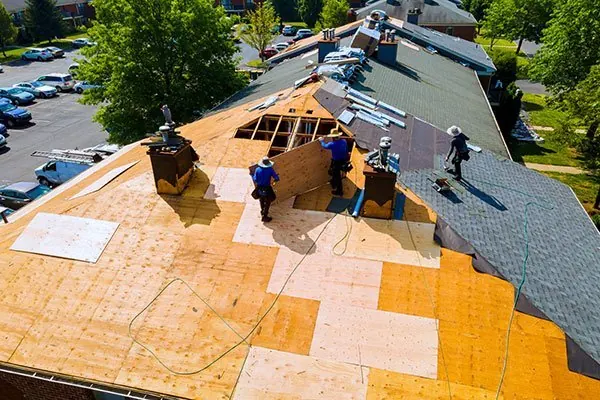
What re-roofing means for a Perth house
Re-roofing replaces the covering of your roof while keeping the existing frame. Roofing Perth arranges re-roofing across the Perth metro area, most often tile-to-Colorbond conversions on 1970s to 1990s brick-and-tile homes and metal-to-metal re-roofs on older homes with galvanised iron. The work is done by independent local roofing contractors, and the quote comes after someone has been on the roof.
A re-roof is a chance to fix things that are hard to reach any other time: sagging battens, missing sarking, undersized gutters, poor ventilation and old flashings around chimneys and skylights.
Tile to Colorbond
This is the re-roof most Perth homeowners ask about. Concrete tiles laid decades ago have usually lost their surface coating, the ridge pointing has cracked, and walking on them breaks more than it fixes. Swapping to steel:
- removes a great deal of weight from the frame;
- gives a roof with far fewer joins for wind-driven rain to get through;
- lets you choose a lighter colour that reflects more summer heat;
- usually means new battens at steel spacing, new fascia or gutter details at the eaves, and new flashings everywhere the roof meets a wall.
Things to settle before you sign: the steel grade if you are near the coast, the colour (some estates and strata schemes restrict it), and how the roofer will handle chimneys, skylights and existing solar.
Metal to metal
Older homes in suburbs closer to the city, and many weatherboard and fibro cottages, carry galvanised or early Zincalume roofs that are now rusting at laps, nail holes and gutter lines. A metal-to-metal re-roof is usually faster than a tile conversion because the batten spacing is already close to right. It is also a chance to change from nails to screws, add a blanket and fix any spots where the pitch is too shallow for the old profile.
See metal roof replacement for more on this kind of job.
Re-tiling
Some owners prefer to stay with tiles, especially where the street is mostly tiled or the house has a steep pitch that suits them. Re-tiling means stripping, re-battening, laying new sarking and new tiles, then bedding or mechanically fixing the ridges. It is slower and heavier work than steel. See tile roof replacement.
Asbestos roofs
If your roof is asbestos cement, the removal must be handled differently. WorkSafe WA requires a licensed asbestos removalist when more than 10 square metres of asbestos is removed, and the sheets go to a facility licensed to accept them. See asbestos roof replacement.
Before work starts
- Ask whether your local government needs a building permit for the work.
- Move valuables away from manholes and check ceiling insulation is not loose around downlights.
- Arrange access for a bin or truck and tell neighbours if scaffold will go near their fence.
- Ask the roofer for their registration and insurance details, and get the scope in writing.
For a sense of prices before you call, see our roof replacement cost guide.